
Why Construction Companies Fail:
5 Financial Mistakes Contractors Should Avoid
Your schedule is full. Your crews are working. Equipment is moving, projects are getting completed, and new opportunities keep coming in.
From the outside, the business looks busy.
But there's a question every construction business owner eventually has to answer:
Are we actually making money on all this work?
Construction companies don't struggle simply because they aren't good builders. A contractor can deliver quality work, have a strong reputation, and maintain a healthy backlog while still experiencing financial pressure behind the scenes.
The problem is often not the amount of work coming in. It's whether the business has the financial visibility and systems needed to turn that work into sustainable profit and cash flow.
Here are five financial mistakes construction business owners should watch for as their companies operate and grow.
CONSTRUCTION BUSINESS FUNDAMENTALS
Why Can a Busy Construction Company Still Struggle Financially?
One of the easiest traps in construction is using activity as the primary measure of success.
A full schedule feels good. So does increasing revenue.
But revenue, profit, and cash are different things.
Revenue tells you how much business you're generating.
Profit tells you what's left after the costs of earning that revenue.
Cash is what allows you to make payroll, pay suppliers, cover insurance, purchase materials, service debt, and keep projects moving.
A contractor can therefore have plenty of work and still experience financial stress.
That's why construction business owners need to look beyond the amount of work on the schedule and understand what the numbers behind that work are actually telling them.
1. Mistaking Being Busy for Being Profitable
More projects do not automatically create a healthier construction company.
A company can increase revenue while margins decline. A project can look successful based on its contract value while unexpected labor, material, equipment, or subcontractor costs quietly reduce the profit.
Instead of asking only:
“How much work do we have?”
construction business owners should also be asking:
“How much money are we actually making on that work?”
Look at the profitability behind the revenue.
Are your jobs producing the margins you expected?
Are actual costs consistently exceeding estimates?
Are certain types of projects more profitable than others?
Being busy is an operational measurement. Profitability tells you whether that activity is financially working.
2. Running the Business Without Knowing the Numbers
Your bank balance is important, but it shouldn't be your entire financial dashboard.
A construction company has several financial indicators that tell different parts of the story, including:
Revenue
Gross profit
Net profit
Cash
Accounts receivable
Backlog
Job costs and job profitability
Looking at these numbers together gives owners a much clearer picture than checking the bank account and assuming everything is fine.
For example, revenue might be increasing while gross profit is declining.
Profit might look positive while accounts receivable continues growing and cash becomes tighter.
Backlog might be strong while the company lacks the labor or working capital necessary to execute all that work comfortably.
Financial reports aren't simply historical paperwork for your accountant. When they are current and understood, they become management tools.
Related CBF Lesson: The 7 Numbers Every Contractor Should Know.
3. Failing to Track Job Costs
Every construction company has projects that perform better than expected and projects that perform worse.
The problem is not knowing which is which.
Contractors need a reliable way to compare what they expected a project to cost against what it actually cost.
That includes tracking items such as:
Labor
Materials
Subcontractors
Equipment
Change orders
Without accurate and timely job costing, a contractor may not recognize that a project is losing margin until the job is nearly complete—or already finished.
That information arrives too late to make meaningful corrections.
Job-cost information should help answer questions such as:
Where did this job perform differently from the estimate?
Did labor take longer than expected?
Did material costs exceed the budget?
Were change orders documented, approved, and billed?
And perhaps most importantly:
What should we change when estimating the next project?
Every completed job should make the company’s estimating and decision-making better.
4. Growing Faster Than Cash Can Support
Growth can be exciting.
It can also consume cash.
Taking on additional work often means adding employees, increasing payroll, purchasing materials, using more equipment, adding vehicles, increasing insurance coverage, and carrying additional overhead.
Many of those expenses happen before the contractor collects the corresponding customer payments.
That creates an important distinction:
More work can increase the need for cash before it increases the cash in your bank account.
A rapidly growing contractor can therefore appear successful while simultaneously putting increasing pressure on working capital.
Before taking on significant growth, owners should consider questions such as:
Do we have enough cash to support this additional work?
How quickly are customers paying us?
Will we need additional employees or equipment?
How will the new work affect payroll and overhead?
What happens if a major customer pays later than expected?
Growth should strengthen the company, not simply make it bigger.
5. Making the Owner the Entire Business
Many construction companies begin with an owner who does almost everything.
The owner estimates jobs, sells work, manages projects, hires employees, handles customer problems, approves purchases, reviews payroll, and keeps an eye on the books.
That may work when the company is small.
But as the business grows, the owner can become the bottleneck.
If every important decision, approval, relationship, and piece of financial knowledge depends on one person, growth becomes increasingly difficult to manage.
Building a stronger construction company means gradually developing systems that allow important information and responsibilities to move through the business without everything depending on the owner.
That includes financial systems.
Owners should have reliable processes for bookkeeping, job costing, billing, collections, financial reporting, and reviewing business performance.
The objective isn't to remove the owner from the company.
It's to give the owner better information and systems so they can spend more time making decisions and less time reacting to problems.
What Do Financially Strong Construction Companies Do Differently?
Strong construction companies don't rely only on instinct or the amount of money currently sitting in the bank.
They build systems that help management see what's happening early enough to respond.
Start with four fundamentals:
Know Your Numbers
Review the financial indicators that tell you whether the company is producing profitable work and maintaining sufficient cash.
Track Every Job
Compare estimates with actual job costs so completed projects improve future estimating and project management.
Protect Cash Flow
Pay attention to billing, collections, payment timing, upcoming obligations, and the cash required to support your workload.
Build Repeatable Systems
Create processes that allow the business to operate consistently without every task and decision depending on the owner.
The goal isn't simply to generate more revenue.
It's to build a construction company that understands where its profit comes from, where its cash is going, and what needs attention before a small financial issue becomes a much larger one.
Start by Understanding the Financial Health of Your Construction Business
You don't have to overhaul every financial system at once.
Start by identifying what you can see clearly today—and where you may have gaps.
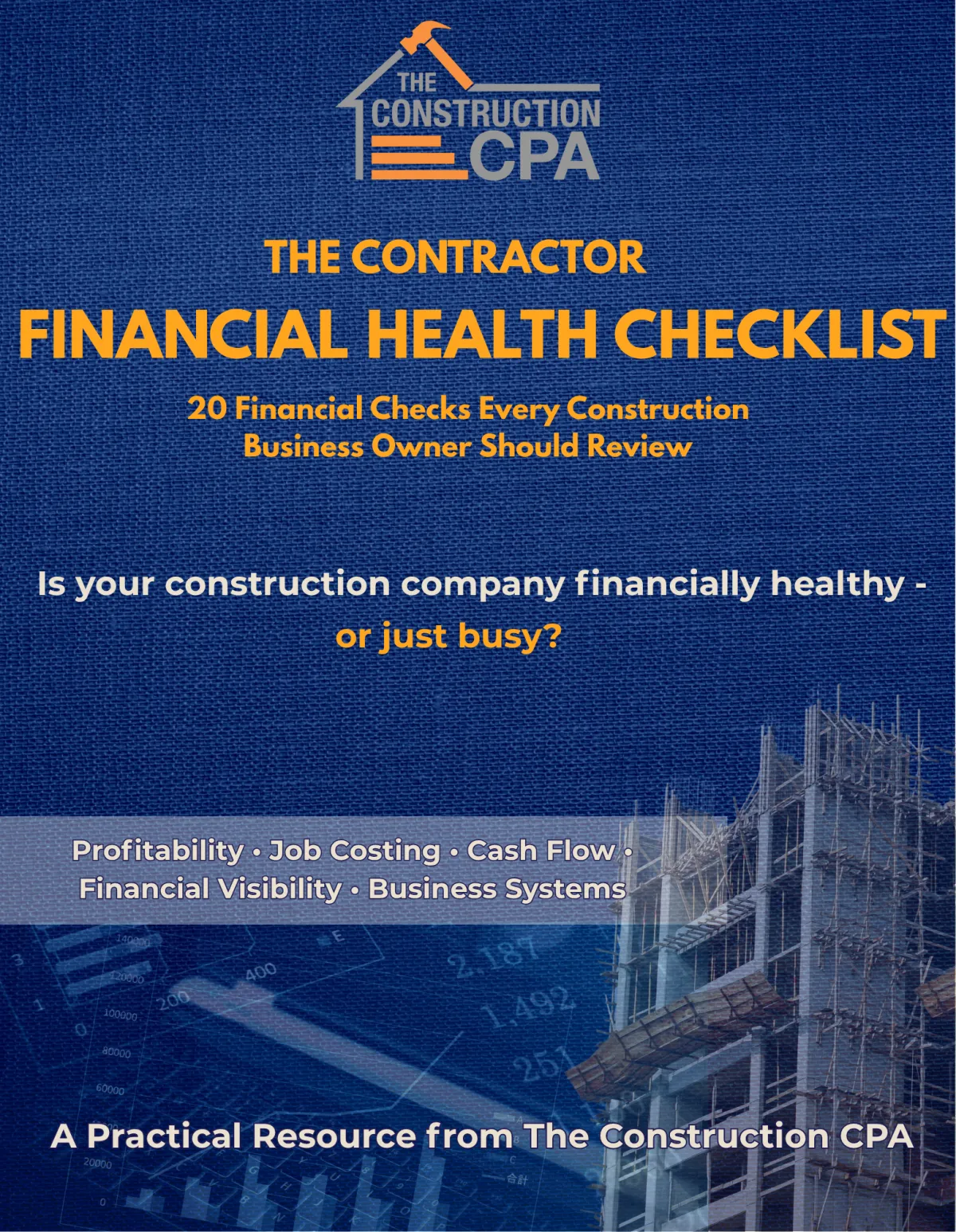
The Contractor Financial Health Checklist from The Construction CPA can help you review key areas of your construction company's financial systems and identify questions worth discussing with your accounting and leadership team.
FREE CONTRACTOR FINANCIAL RESOURCE
Contractor Financial Health Checklist
How financially healthy is your construction business—beyond what your bank balance says? This free 20-point checklist helps you review the financial areas that matter most, identify potential gaps, and determine where your business may need greater visibility and stronger systems.
Know Your Numbers
Track Every Job
Protect Your Cash Flow
Build Financial Systems
CBF EPISODE 1
Why Most Construction Companies Fail (And How to Avoid It)
Many construction companies stay busy but still struggle with profitability, cash flow, and financial visibility. In this episode, learn the common financial warning signs behind construction business failure—and the fundamentals contractors can use to build a stronger, more financially sustainable company.
Construction Business Fundamentals is an educational series from The Construction CPA designed to help contractors better understand the business and financial fundamentals behind building a stronger construction company.
If your construction company is growing and you need help understanding what your financial information is telling you, you can learn more about working with The Construction CPA.
This article is for general educational purposes and is not intended as individualized accounting, tax, or financial advice.

Simplicity
On time, every time

Partnership
We build with you

Excellence
Accurate numbers, reliable results
FOLLOW US


COMPANY
CUSTOMER CARE
Copyright 2026. The Construction CPA. All Rights Reserved.
Built by AxisHub